Work from chat
Ask the agent in messaging apps such as Telegram, WhatsApp, Slack or Discord, or from a web console.
PAI-AGENT
Agents that get work done inside your walls, with you in control.
Hand routine work to AI agents that run on your own infrastructure. Built on the open-source Hermes Agent or OpenClaw, they take requests from the messaging apps your team already uses, remember context, learn reusable skills and run scheduled tasks. Logic Sonata wraps them in a governed sandbox: private models, allow-listed tools, human approval for sensitive actions and a complete audit trail.
01The challenge
Open-source agents can read files, browse the web, run commands and send messages. That is exactly what makes them useful and exactly why they must not run with unchecked access to company systems or public AI services. The value comes from pairing capable agents with strict governance.

02Capabilities
Ask the agent in messaging apps such as Telegram, WhatsApp, Slack or Discord, or from a web console.
Agents remember context across sessions and turn solved problems into reusable, readable skills.
Daily reports, weekly summaries and recurring checks, described in plain language.
Files, spreadsheets, browser and scripts run in an isolated environment with allow-listed access.
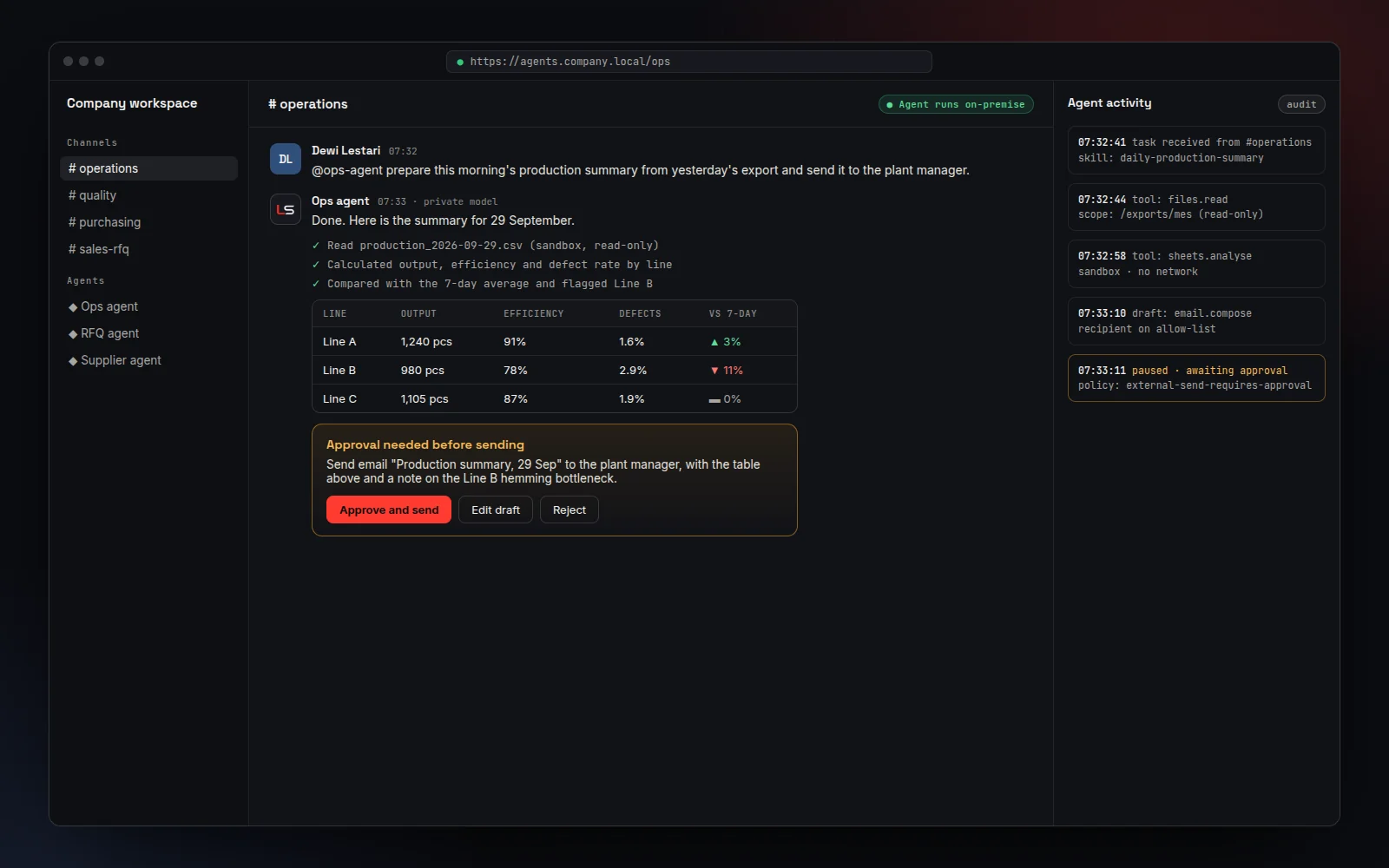
Sending email, updating records or spending money waits for a named approver.
Every plan, tool call, approval and result is recorded and reviewable.
03How it works
Hermes Agent from Nous Research or OpenClaw, both open-source, self-hosted agent frameworks with memory, skills, scheduling and messaging integrations. Logic Sonata selects the framework per use case and adds the governed runtime.

A message, a schedule or an event starts a task.
The agent breaks the task into steps using a private model on the appliance.
Approved tools run in isolation with only the access that task needs.
Sensitive steps pause for human approval in chat or the console.
Results are delivered, logged and captured as reusable skills.
04Example skills
Skills are readable, reusable instructions the agent builds and improves. These are typical first skills for manufacturing and trading companies.
Read yesterday’s production export, calculate output, efficiency and defects by line, and post a summary to the operations channel.
Collect the buyer’s tech pack, past quotations and material prices into a first-draft RFQ response for review.
List purchase orders overdue by more than three days and draft supplier reminders for approval.
Summarise the notes, extract decisions and owners, and post them back to the team.
05Use cases
Pull exports from ERP or MES, calculate KPIs and deliver a summary before the morning meeting.
Collect specifications, past quotes and requirements into a first draft for review.
Track open purchase orders and draft chasers for approval.
Classify incoming requests, extract key data and route them to the right team.
Summaries, decisions and owners, posted back to the team channel.
Research through approved sources, summarised weekly.
06Security and governance
Every Logic Sonata system runs on hardware you control, with access, audit and data boundaries designed in from the start.
07FAQ
Both are capable open-source agents. We recommend one based on your channels, tasks and security requirements, and deploy it inside the same governed runtime.
Only within the limits you set. Read-only and internal steps can run automatically; anything external or irreversible waits for approval.
Files, spreadsheets, email, messaging apps and business systems with an API or export. Each connection is allow-listed and scoped.
08More from Logic Sonata
A governed assistant that answers questions from your SOPs, specifications, policies and reports. Every answer cites its source and every user sees only what their role allows.
Real-time analysis of live camera feeds by a vision-language model on your appliance. Ask what is happening on a line, at a dock or at an entrance, without video leaving your premises.
Code completion, repo-aware chat, review and agentic coding in the tools your developers already use, powered by open coding models on your own hardware.
A ready-to-use image generation studio built on ComfyUI, preinstalled with curated models and templates, so designers create prints, concepts and campaign visuals without their work leaving the building.
Get started
Book a 30-minute consultation. We will show the system working and scope a pilot around your use case.